

 Merryl
Most buyers in Dubai do not pay the full price in cash. A mortgage lets you keep capital free for other investments, but the rules on how much you can borrow are set by the UAE Central Bank and are stricter than in many countries. Knowing them before you start viewing properties saves time and avoids disappointment.
Loan-to-Value (LTV) Limits in 2026
The LTV is the share of the property value a bank can lend. The value used is the lower of the purchase price and the bank’s own valuation.
| Buyer | Property | Maximum loan | Minimum down payment |
|---|---|---|---|
| Expat resident | First home under AED 5M | 80% | 20% |
| Expat resident | First home AED 5M and above | 65% | 35% |
| Expat resident | Second home / investment | 60% | 40% |
| UAE national | First home under AED 5M | 80% | 20% |
| UAE national | First home AED 5M and above | 70% | 30% |
| Non-resident | Any | About 50% to 60% (bank dependent) | 40% to 50% |
Off-plan: many banks do not finance off-plan units during construction, and those that do usually cap the loan around 50%. Most off-plan buyers pay construction instalments in cash and use a mortgage for the final handover payment.
The 50% Debt Burden Rule
Your total monthly debt repayments, including the new mortgage, car loans and credit card limits, cannot exceed 50% of your gross monthly income. This rule often limits the loan more than the LTV does, so clear or reduce other debts before you apply.
Who Can Get a Mortgage?
- Minimum income: banks commonly look for AED 10,000 to 15,000 per month for residents. Non-residents usually need a higher income, often the equivalent of AED 30,000 or more.
- Loan term: up to 25 years. Most banks require the loan to end before you reach 65 if salaried, or around 70 if self-employed.
- Employment history: salaried applicants usually need at least six months with their current employer; self-employed applicants typically need two years of audited accounts or bank statements.
Fixed or Variable Rate?
Dubai mortgages are priced against EIBOR, the UAE’s interbank rate. You can choose:
- Fixed rate for 1 to 5 years, then a variable rate. Predictable payments, usually a slightly higher starting rate.
- Variable rate linked to EIBOR plus a margin. Payments move with the market.
Also check the early settlement fee. UAE rules cap it at 1% of the outstanding balance or AED 10,000, whichever is lower.
Documents You Will Need
- Passport, visa and Emirates ID (residents)
- Salary certificate and last six months of payslips, or company documents if self-employed
- Last six months of bank statements
- For non-residents: proof of income and credit report from your home country
- Memorandum of Understanding (Form F) once you have agreed the purchase
Step by Step: From Pre-Approval to Keys
- Get pre-approval. It tells you your real budget and is usually valid for about 60 days.
- Agree the property and sign Form F with the seller, paying the agreed deposit.
- Bank valuation of the property.
- Final offer letter from the bank.
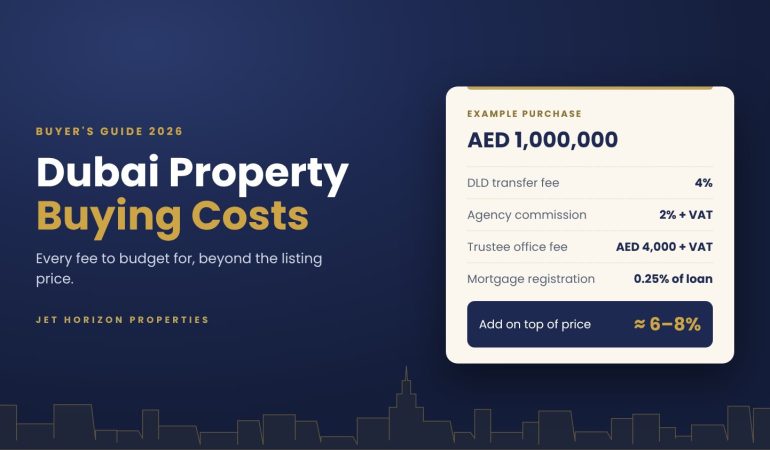
- Transfer at the trustee office, where the bank pays the seller and the mortgage is registered with the DLD (0.25% of the loan).
Common Mistakes to Avoid
- Signing Form F before checking how much you can borrow
- Forgetting that fees of around 6% to 8% are paid in cash on top of the down payment. See our full breakdown of buying costs.
- Comparing banks only on the headline rate instead of total cost over the fixed period
- Applying to many banks at once, which can affect your credit score
Frequently Asked Questions
Can I get a mortgage if I live outside the UAE?
Yes. Several UAE banks lend to non-residents, usually up to 50% to 60% of the value, with stricter income checks.
Does buying with a mortgage qualify me for the Golden Visa?
It can. Mortgaged properties are accepted under the property route if conditions are met. Read our Golden Visa through property guide.
Plan Your Purchase With the Right Numbers
Contact Jet Horizon Properties and we will help you estimate your budget, connect you with mortgage advisers and shortlist properties that fit. Browse properties for sale.
Lending rules are based on UAE Central Bank regulations and common bank practice as of October 2026. Each bank applies its own criteria. This article is for information only and is not financial advice.

 English
 العربية